
 By Declan Barry
Domestic Flights in Japan vs the Shinkansen: An Honest Comparison
You're planning your Japan itinerary and facing the classic traveller's dilemma: should you fly from Tokyo to Osaka, or take the shinkansen? What about reaching Hokkaido or Kyushu? The answer isn't always straightforward, and neither option is universally "better". Let's break down the real costs, times, and practical considerations so you can make the right choice for your specific journey.
Tokyo
Tokyo Tower
Reminiscent of the Eiffel Tower, this landmark features observation areas & other attractions.
Open in Maps ↗Osaka
Osaka Castle
Revered castle dating to 1597 & since rebuilt, featuring gardens & a museum with varied exhibits.
Open in Maps ↗The True Cost: Beyond the Ticket Price
Shinkansen Pricing Reality
The shinkansen operates on a straightforward pricing model. Tokyo to Osaka on the Nozomi (fastest service) costs ¥13,320 for an unreserved seat, ¥13,870 for a reserved ordinary seat, and ¥19,590 for Green Car (first class). That price is what you pay, full stop.
However, if you're visiting Japan as a tourist, the JR Pass changes everything. A 7-day ordinary pass costs ¥29,650 (as of 2024), and whilst you can't use it on the fastest Nozomi or Mizuho services, the slightly slower Hikari trains get you from Tokyo to Osaka in just 3 hours versus 2 hours 30 minutes. If you're making even two long-distance journeys during your week in Japan, the pass pays for itself.
Sapporo
JR Tower
Opened in 2003, the 173-m high skyscraper houses a shopping mall, office complex & observation deck.
Open in Maps ↗Domestic Flight Pricing: The Variables
Japan's domestic flight market is competitive, with ANA and JAL as the major carriers, plus budget airlines like Peach, Jetstar Japan, and Skymark. A Tokyo (Haneda) to Osaka (Itami) flight might cost anywhere from ¥8,000 to ¥25,000 depending on when you book and when you fly.
The critical factor: advance booking. Purchase three months ahead and you'll find promotional fares around ¥8,000-10,000. Book a week before travel and expect ¥20,000 or more. Weekend and holiday flights command premium prices, whilst midweek morning flights often offer the best deals.
Budget carriers flying into secondary airports (like Kansai instead of Itami, or Narita instead of Haneda) can undercut even the promotional fares, sometimes dropping below ¥6,000. But those savings come with trade-offs we'll explore shortly.
The Time Factor: Door to Door
Shinkansen: Predictable and Central
The shinkansen's greatest advantage is that it connects city centre to city centre. Tokyo Station sits in the heart of the capital, perfectly positioned on multiple metro lines. Shin-Osaka Station connects directly to Osaka Station via a 4-minute local train.
Let's map a realistic Tokyo-to-Osaka journey:
- Travel to Tokyo Station from your hotel: 15-30 minutes
- Arrive and board (no security, no check-in): 5 minutes
- Journey time (Hikari train): 3 hours
- Exit and reach your Osaka hotel: 15-30 minutes
- Total: 3 hours 35 minutes to 4 hours 5 minutes
The shinkansen departs every 10-20 minutes during peak hours. Miss your planned train? Simply board the next one (with unreserved seats or flexible reserved tickets).
Domestic Flights: The Airport Penalty
Flying looks faster on paper. Tokyo Haneda to Osaka Itami takes just 1 hour 15 minutes airborne. But aeroplanes don't leave from city centres.
The same journey by air:
- Travel to Haneda Airport from central Tokyo: 30-45 minutes (monorail or train)
- Arrive before departure (domestic flights): 45-60 minutes
- Security and boarding: 15-20 minutes
- Flight time: 1 hour 15 minutes
- Disembark and collect baggage (if checked): 20-30 minutes
- Travel from Itami Airport to Osaka centre: 30-40 minutes (bus or monorail)
- Total: 3 hours 35 minutes to 4 hours 30 minutes
Suddenly, that flight saves you nothing. And unlike the shinkansen, missing your specific departure means rebooking fees or buying a new ticket.
When Flying Makes Undeniable Sense
Long-Distance Routes
The shinkansen network, whilst extensive, has geographical limits. The Hokkaido Shinkansen reaches Hakodate but takes 4 hours from Tokyo and doesn't yet extend to Sapporo (that section opens in 2031). Flying Tokyo to Sapporo takes 1 hour 40 minutes airborne, and even with airport time, you'll arrive roughly 3 hours faster than taking trains.
Similarly, reaching Kyushu from Tokyo or Osaka makes flying attractive. Tokyo to Fukuoka is 2 hours by air versus 5 hours on the shinkansen. Tokyo to Kagoshima? The flight wins decisively: 2 hours airborne versus nearly 7 hours by train.
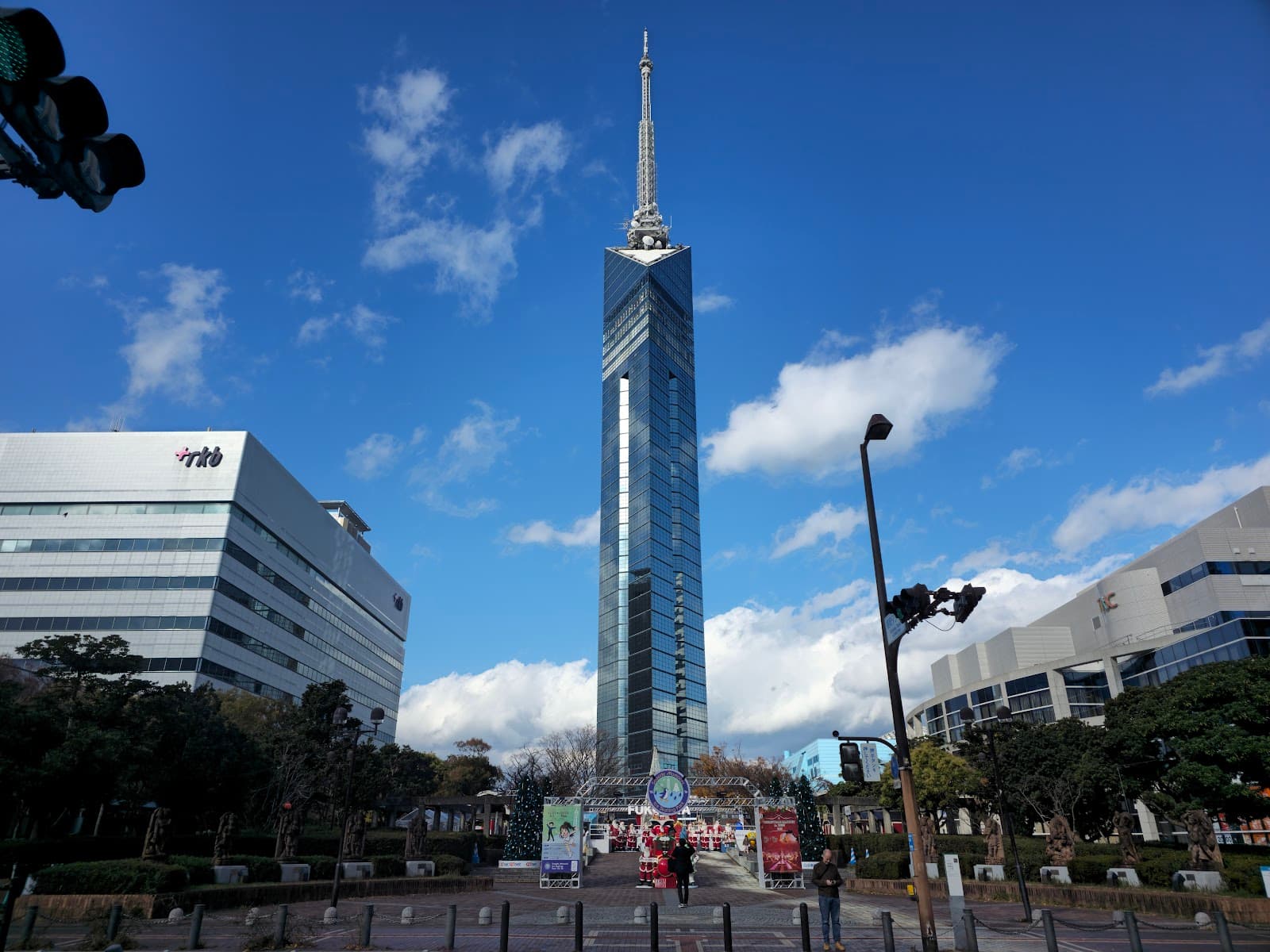
Fukuoka
Fukuoka Tower
Modern skyscraper with an observation deck for panoramic city & bay views, plus dining & a lounge.
Open in Maps ↗Okinawa presents no contest. No trains reach Japan's subtropical islands. Flying is your only realistic option, with Tokyo to Naha taking approximately 2 hours 45 minutes.
Budget Carrier Sweet Spots
If you're travelling without a JR Pass and booking well ahead, budget carriers offer genuine savings on routes like:
- Osaka (Kansai) to Sapporo: ¥8,000-12,000 versus ¥37,000+ by train
- Tokyo (Narita) to Fukuoka: ¥7,000-11,000 versus ¥22,950 by shinkansen
- Osaka to Okinawa: ¥10,000-15,000 (no train alternative exists)
The secondary airports (Narita and Kansai) add travel time, but the savings can be substantial.
When the Shinkansen Wins
The Tokyo-Osaka-Kyoto Golden Triangle
For Japan's most travelled route corridor, the shinkansen is simply superior. Tokyo to Kyoto takes 2 hours 15 minutes on the Nozomi (2 hours 45 minutes on the Hikari with a JR Pass). You'll spend longer getting to and from airports than you save in the air.
Osaka to Tokyo flights land at either Haneda (convenient) or Narita (adding an hour each way). Meanwhile, shinkansen trains depart Shin-Osaka every 12 minutes during the day. The flexibility alone settles the question.
JR Pass Scenarios
With a JR Pass, most shinkansen journeys become "free" (already paid for). Flying Tokyo to Hiroshima would cost ¥20,000-30,000. The shinkansen takes 4 hours but costs you nothing beyond your pass. You'd need to genuinely value those saved hours to justify the expense.
The pass also covers local JR trains at your destination, something your flight ticket doesn't include.
Weather Reliability
Typhoons, winter storms, and heavy snow can ground flights or cause significant delays. The shinkansen, running on dedicated elevated tracks, rarely stops. During my visits, I've seen Narita Airport closed whilst shinkansen services continued normally.
If you're on a tight schedule, particularly connecting to an international flight home, the shinkansen's reliability provides peace of mind worth more than time or money savings.
Comfort and Convenience Considerations
Luggage: A Critical Difference
The shinkansen requires you to manage your own luggage. Large suitcases technically need advance reservation for designated spaces (introduced in 2020), though enforcement is inconsistent. Overhead racks fit small bags; large bags typically go in the space behind the last row of seats or at your feet.
Domestic flights in Japan allow cabin baggage up to 10kg (budget carriers) or 115cm total dimensions (full-service carriers). Anything larger gets checked, adding 20-30 minutes at each end for drop-off and collection. However, once checked, your bags aren't your problem until arrival.
Work and Connectivity
Shinkansen seats offer more space than economy aircraft seats, with generous legroom and reclining ability. Most trains now provide power outlets and free Wi-Fi (though Wi-Fi quality varies). You can work on a laptop comfortably throughout the journey.
Domestic flights offer Wi-Fi on some services, but the shorter flight time and smaller tray tables make sustained work less practical. If you're planning to be productive during travel, the shinkansen wins.
The View
This matters more than you might think. The Tokaido Shinkansen between Tokyo and Osaka passes Mount Fuji on clear days. The Hokuriku Shinkansen traverses stunning mountain scenery. The journey itself becomes part of your experience.
Flights offer views only to window-seat passengers, and cloud cover frequently obscures the ground. You're trading scenery for speed.
Practical Booking Considerations
Shinkansen Tickets
Purchase at any JR station ticket office, through JR's website (English available), or at ticket machines (English option). Reserved seats can be booked up to one month in advance; unreserved seats need no advance purchase.
The Tokaido Sanyo Shinkansen also offers an excellent English-language app (EX App) allowing ticket purchase and electronic boarding. Simply scan a QR code at the gate.
Flight Bookings
Book through airline websites, comparison sites, or travel agents. Full-service carriers (ANA, JAL) allow changes for a fee; budget carriers typically make changes expensive or impossible. Read the fare conditions carefully.
Domestic flights require identification (passport for foreign visitors). Bring it to the airport or you won't board.
Environmental Considerations
The shinkansen runs on electricity, much of which now comes from renewable sources. Per passenger kilometre, it produces significantly less CO2 than flying. If environmental impact influences your decisions, trains win substantially.
My Honest Recommendations
Choose the Shinkansen When:
- Travelling Tokyo-Osaka-Kyoto or any route under 4 hours by train
- You hold a JR Pass
- You value flexibility (departing when you want, not when booked)
- You're carrying substantial luggage
- You want to work or relax during the journey
- Weather reliability matters for your schedule
Choose Flying When:
- Travelling to Hokkaido (Sapporo), distant Kyushu, or Okinawa
- You don't have a JR Pass and can book budget flights well ahead
- You've found promotional fares under ¥10,000
- Time genuinely matters more than cost or experience
- You're comfortable with the airport experience and logistics
The Mixed Strategy:
Many travellers use both. Fly into Sapporo or Fukuoka at the start or end of your trip, then use the shinkansen for the Tokyo-Osaka-Kyoto corridor where it excels. This combines each mode's strengths whilst avoiding their weaknesses.
Final Thoughts
Japan's domestic transport network offers choices most countries can't match. Both the shinkansen and domestic flights work brilliantly, just for different situations. The "best" option depends entirely on your specific route, whether you hold a JR Pass, how far ahead you can book, and what you value in travel.
For most first-time visitors focusing on Tokyo, Kyoto, and Osaka, the shinkansen will serve you better. It's more flexible, more comfortable, and with a JR Pass, more economical. But when you're ready to explore Hokkaido's snow festivals, Kyushu's hot springs, or Okinawa's beaches, don't hesitate to fly. That's when aircraft truly earn their wings.
The real winner? You, for having such excellent options.