
 By Declan Barry
Western Honshu runs out of road at the Kanmon Straits, where a narrow channel separates the main island from Kyushu. The two cities that bookend this corner - Yamaguchi, with its pagodas and ink-wash gardens, and Shimonoseki, where fugu has been the local obsession for centuries - sit within 30 kilometres of each other and reward a stay of two to three nights combined. Neither city draws the crowds of Hiroshima or Kyoto, which means you get the monuments largely to yourself and the restaurant queues are manageable.
Getting There: Shinkansen Access
Both cities are served by Nozomi and Sakura shinkansen on the JR San'yo/Kyushu line. Shin-Yamaguchi Station is the gateway for Yamaguchi city: from Hiroshima it takes about 30 minutes (¥3,620 reserved on the Nozomi), from Osaka about 1 hour 40 minutes (¥10,360), and from Hakata (Fukuoka) about 25 minutes (¥2,810). Shin-Yamaguchi is not in the city centre - allow another 30 minutes on a local JR bus or the infrequent JR Yamaguchi Line to reach central Yamaguchi.
Shin-Shimonoseki Station handles shinkansen traffic for Shimonoseki. It sits in the city's western outskirts, and JR Sanyo Line local trains connect it to the more useful Shimonoseki Station (near Karato Market) in about 10 minutes (¥200). Alternatively, Shimonoseki Station itself receives limited Kodama services. If you are coming from Kyushu, Hakata to Shin-Shimonoseki is only 17 minutes on the Nozomi (¥1,970).
A practical routing for a western Honshu trip: arrive into Shin-Yamaguchi from Hiroshima, spend a night or two in Yamaguchi city, then take the local JR San'yo Line west to Shimonoseki (about 40-50 minutes, ¥970) and continue to Kyushu via Hakata. The Railpass covers all of this.
Yamaguchi City: The Shrunk-Down Cultural Capital
Yamaguchi earned its nickname the "Kyoto of the West" during the Sengoku period (15th to 16th centuries), when the Ouchi clan made it a refuge for Kyoto aristocrats fleeing civil war. The cultural infrastructure they built - temples, gardens, a taste for refinement - has outlasted the clan itself. The city today has a population of around 190,000 and a slow, uncrowded quality that makes the monuments easier to absorb.
Ruriko-ji Temple and the Five-Storey Pagoda
The Ruriko-ji Five Story Pagoda (4.5★) is the most architecturally significant structure in the prefecture. Built in 1442, it stands in Kozan Park (4.2★) at the north end of the city, a wooded hillside setting that keeps it readable against the treeline whatever the season. The pagoda itself is free to view from the grounds; Kozan Park has no entrance charge. Arrive before 9 am if you want it without a tour group - the park gates open early and most visitors arrive mid-morning.
Yamaguchi
Ruriko-ji Five Story Pagoda
Pagoda overlooking a landscaped park, a popular viewing point for cherry blossoms & fall colors.
Open in Maps ↗Yamaguchi
Kozan park
Serene, historical green space with seasonal cherry blossoms, sculptures & a 5-tiered pagoda.
Open in Maps ↗The adjacent Rurikoji Temple (4.4★) manages the grounds and has a small exhibition hall. Combined, the site takes about 45 minutes at a reasonable pace.
Yamaguchi
Rurikoji Temple
A grand, 5-story pagoda anchors this 15th-century Buddhist temple with an elaborate garden.
Open in Maps ↗Jyoei-ji Temple and Sesshu's Garden
Jyoei-ji Temple and Sesshu's Garden (4.2★) sits in the forested hills to the south-east of the city centre and takes about 20 minutes by taxi from Yamaguchi Station (roughly ¥1,500). The garden was designed in the late 15th century by Sesshu Toyo, the ink-wash painter, and is modelled on landscape-painting principles rather than the strolling-garden conventions more common in Kyoto. It uses a karesansui (dry landscape) structure with a rear hill as borrowed scenery, and the proportions are noticeably different from anything you will see on the tourist circuit. Entrance is ¥300. The garden is small - you can take it in properly in 30 minutes - but it repays sitting still for a while.
The temple itself has a direct connection to Sesshu's time in China, and the small on-site notice boards explain the painting-to-garden translation in enough detail to make the design legible even if you have no prior knowledge of the painter.
Yuda Onsen
Yuda Onsen is Yamaguchi's hot spring district, about 3 kilometres from central Yamaguchi and reachable by JR Yamaguchi Line to Yuda-Onsen Station (6 minutes, ¥200). The springs are sodium chloride, clear, and relatively mild in temperature (around 72°C at source, cooled for bathing). This is not a resort town in the Hakone mould - it is a working onsen district with a shopping street and a cluster of mid-range ryokan and business hotels that cater largely to domestic travellers. Day-use bathing is available at several facilities from around ¥500. The district is quiet on weekday mornings and practical as a base for the city.
Akiyoshido Cave
Akiyoshido is Japan's largest limestone cave system, about 45 kilometres north of Yamaguchi city. Direct buses run from Shin-Yamaguchi Station (about 45 minutes, ¥860). The accessible section is 1 kilometre long and walks you past active speleothems - stalactites, stalagmites, and the hundred-dish formation (hyakumai-zara), a terraced limestone shelf that looks like stacked plates. Temperature inside is a constant 17°C regardless of season, so bring a layer. Entrance is ¥1,300. The surrounding Akiyoshi Plateau above the cave is a karst grassland worth the extra 15 minutes if the weather is clear, but the plateau overlook is a separate ¥1,100 lift or a 20-minute uphill walk.
Note: Akiyoshido adds a substantial half-day to your Yamaguchi visit. It is best treated as a dedicated excursion rather than a quick add-on to the city temples.
Yamaguchi Xavier Memorial Church
The Yamaguchi Xavier Memorial Church (4.1★) commemorates Francis Xavier's 1550 stay in the city, during which he preached for two months under Ouchi clan protection. The current building is a 1998 reconstruction after a fire, and it is a genuinely unusual piece of architecture - a modernist concrete structure with twin towers and a small museum documenting Xavier's Asian itinerary. Entrance to the museum is ¥200. The church is five minutes on foot from Yamaguchi Station and takes about 30 minutes to visit properly.
Yamaguchi
Yamaguchi Xavier Memorial Church
Rebuilt modernist church, with exhibits on the journeys of 16th-century Jesuit, Francis Xavier.
Open in Maps ↗Shimonoseki: The Strait City
Shimonoseki faces Kyushu across a 700-metre channel that has been one of Japan's most strategically significant waterways for over a millennium. The 1185 Battle of Dan-no-ura, which ended the Genpei War and established samurai rule, was fought on these waters. The 1895 Treaty of Shimonoseki, which ended the First Sino-Japanese War, was signed in the city. And today, the Kanmon Straits carry some of the heaviest maritime traffic in Japan - watching the cargo ships pass from the waterfront is genuinely compelling, not a staged attraction.
Karato Market and Fugu
Shimonoseki supplies roughly 80 per cent of Japan's commercial fugu (pufferfish), and the Karato Fish Market (4.1★) is the main retail and food hub for it. The market is open daily; the best time to visit is Friday or Saturday morning when the retail stalls are busiest, and a sashimi set (fugu sashimi, called tessa locally) runs from about ¥1,500 at market stalls. The fish itself has a delicate, almost neutral flavour with a firm texture that responds well to ponzu. If you have had sashimi elsewhere and found the texture interesting, fugu is worth trying here where the price is significantly lower than in Tokyo or Osaka.
Shimonoseki
Karato Fish Market
Large, bustling market featuring many vendors selling sashimi & sushi, plus other prepared foods.
Open in Maps ↗The market is a 5-minute walk from Shimonoseki Station. Note that the full restaurant experience - a multi-course fugu kaiseki - starts at around ¥8,000 per person at the specialist restaurants around Karato.
Akama-jingu Shrine
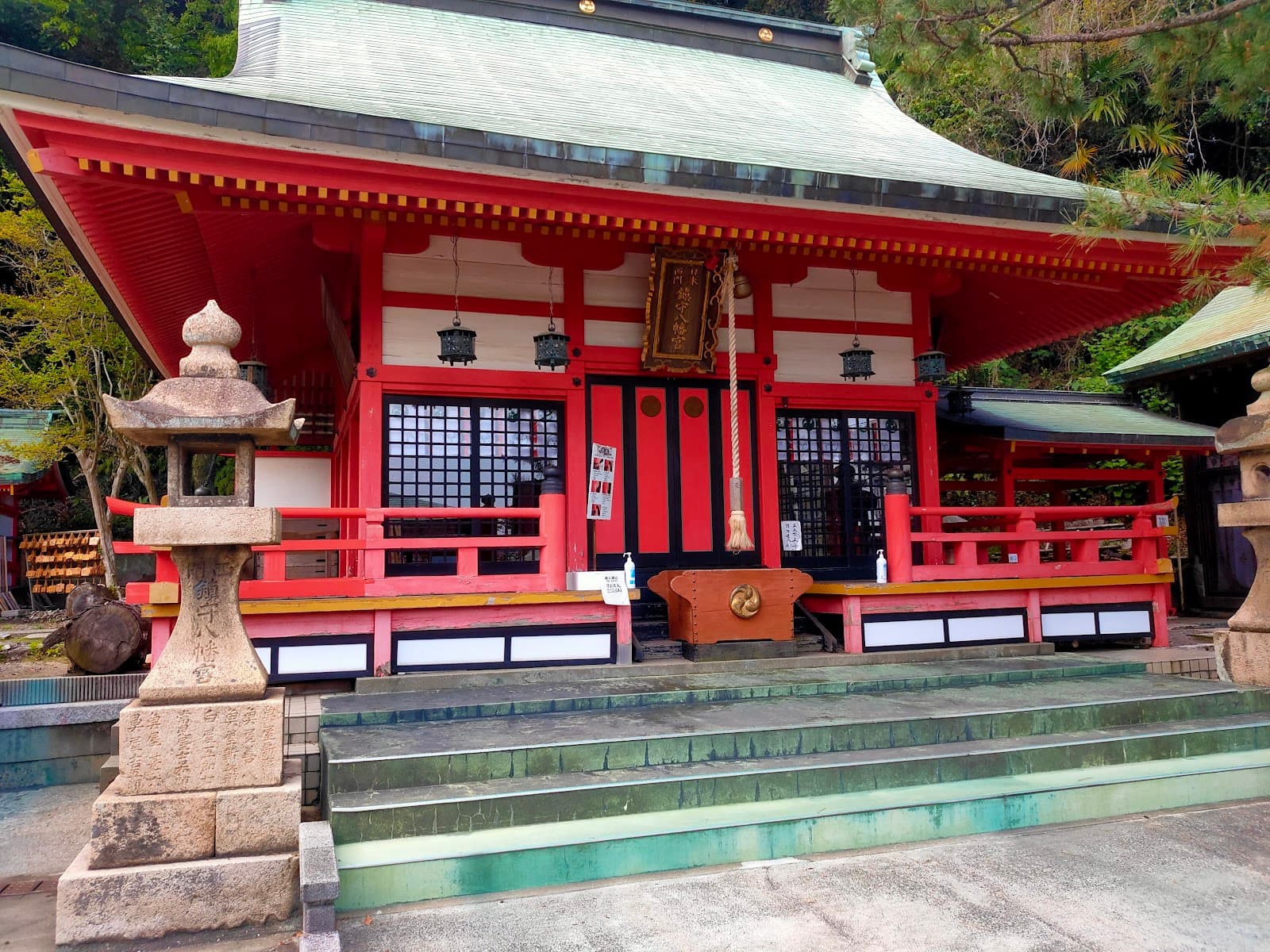
Akama-jingu Shrine (4.2★) stands at the water's edge about 1.5 kilometres east of Karato Market, and it is dedicated to the 7-year-old Emperor Antoku, who drowned at Dan-no-ura in 1185 when the Taira clan chose death over surrender. The shrine's distinctive bright red main gate and vermilion buildings are set against the strait, with the water visible behind the structures. The Hoichi-do hall references the Lafcadio Hearn story of Hoichi the Earless, which is set at this location. Free to enter. Allow 20 minutes.
Shimonoseki
Akama-jingu Shrine
Shinto shrine dedicated to a 12th-century child emperor, with a distinctive bright red main gate.
Open in Maps ↗Immediately adjacent, the Dannoura Battlefield (4.1★) is a slim waterfront strip with bronze statues representing the Heike and Genji commanders. It is not a conventional sightseeing spot - there is no infrastructure beyond the statues and a path - but standing at the water's edge with the actual straits in front of you gives the 1185 battle a useful physical context.
The Kanmon Pedestrian Tunnel
Below the strait runs a pedestrian and cycling tunnel connecting Honshu to Kyushu. The entrance on the Shimonoseki side is at Mimosusogawa Park (4.1★), near the Dannoura statues. The tunnel is 780 metres long, takes about 15 minutes to walk, and is free for pedestrians (cyclists pay ¥20). Crossing the prefectural boundary mid-tunnel - the floor is marked - is a low-key but concrete experience of moving between two of Japan's main islands on foot. The tunnel is open 6 am to 10 pm daily. This is more interesting as an activity than it sounds: most visitors cross the Kanmon by bridge or ferry without realising the foot tunnel exists.
Kaikyokan Aquarium
Kaikyokan (4.3★) is Shimonoseki's city aquarium, notable for housing more species of pufferfish than any other facility in Japan - around 30 species, including the tiger fugu used in cooking. There is also a dolphin show and a tunnel tank with penguins. Entrance is ¥2,090 for adults. It is a well-maintained facility that takes 90 minutes to cover properly and is a practical option if you are travelling with children or want to see the fish in a different context from the market. It sits adjacent to Kaikyo Plaza on the waterfront.
Kaikyo Yume Tower
The Kaikyō Yume Tower (4.1★) is a 153-metre observation tower about 10 minutes on foot from Shimonoseki Station, with a glass-domed observation deck at the top. The view covers the Kanmon Strait, the bridges to Kyushu, and the surrounding coastal hills. Admission to the observation deck is ¥600. The tower itself is not architecturally remarkable, but the deck delivers a clear picture of the strait's geography and the volume of maritime traffic in a way that ground-level views do not.
The Moji Retro Area (Day Trip from Shimonoseki)
From Shimonoseki, the ferry to Moji Port (Kitakyushu, Fukuoka Prefecture) takes 5 minutes and costs ¥400 - it departs from near the aquarium. Mojiko Retro (4.3★) on the Kyushu side is a preserved Meiji-era port district with red-brick warehouses, the Former Moji Customs Office (4.1★) from 1912, and the Kyushu Railway History Museum (4.3★) with original steam engines and early rolling stock. The Mojiko Retro Observation Gallery (4.2★) offers elevated views back across the strait to Shimonoseki. Allow two to three hours for a comfortable visit. This is technically Kyushu but it functions as an extension of the Shimonoseki waterfront itinerary.
Pairing the Two Cities: A Practical Itinerary Frame
Day 1 - Yamaguchi: Arrive into Shin-Yamaguchi mid-morning. Bus or train to the city centre. Afternoon at Kozan Park and Ruriko-ji. Evening in Yuda Onsen. Night in Yamaguchi or Yuda Onsen.
Day 2 - Yamaguchi: Morning at Jyoei-ji and Sesshu's Garden, afternoon at Akiyoshido (if the cave is a priority), or Xavier Memorial Church and a more leisurely afternoon. Late afternoon JR San'yo Line west to Shimonoseki (45-50 minutes, ¥970 from Yamaguchi Station via local train; change may be needed at Ogori).
Day 3 - Shimonoseki: Morning at Karato Market for fugu sashimi. Walk to Akama-jingu and Dannoura. Pedestrian tunnel crossing. Afternoon at Kaikyokan or Kaikyo Yume Tower. Optional: ferry to Moji for the Retro district. Depart from Shin-Shimonoseki or continue into Kyushu.
Honest Caveats
Yamaguchi city has limited evening options compared to a larger city. The central restaurant scene is thin by 9 pm; Yuda Onsen has more life on weekday evenings. Shimonoseki is better for dining out late, with the Karato area having several fugu restaurants open until 10 pm.
Akiyoshido is genuinely worth the detour but adds half a day and is difficult without a car unless you time the Shin-Yamaguchi bus carefully. Check the bus timetable from Shin-Yamaguchi before building it into your itinerary.
The Moji Retro area involves leaving Yamaguchi Prefecture entirely, which matters if you are on a regional pass rather than a national JR Pass. The ferry from Shimonoseki is not covered by JR Pass.
Crowds are not generally a problem at any of these sites outside Golden Week (late April to early May) and Obon (mid-August). Ruriko-ji pagoda in cherry blossom season (late March to early April) is busier than usual but still manageable compared to Kyoto equivalents.