
 By Declan Barry
Walking Eastern Kyoto: Ginkaku-ji to Kiyomizu-dera
The eastern hills of Kyoto hold one of Japan's finest walking routes. Starting at the Silver Pavilion (Ginkaku-ji) and finishing at the wooden terraces of Kiyomizu-dera, this 6-kilometre walk threads together temples, shrines, traditional streets, and hillside gardens. You'll need roughly four to five hours, including stops, and you'll finish with a proper understanding of why Kyoto remains Japan's cultural heart.
Kyoto
Ginkaku-ji
This 15th-century Zen temple features picturesque gardens & a sand mound shaped like Mount Fuji.
Open in Maps ↗Kyoto
Kiyomizu-dera
Iconic Buddhist temple on Mount Otowa known for the scenic views afforded from its sizable veranda.
Open in Maps ↗This route follows the Philosopher's Path (Tetsugaku-no-michi) before diving into the atmospheric lanes of Higashiyama district. Along the way, you'll pass through quiet bamboo groves, climb stone-paved slopes lined with tea houses, and discover temples that predate the Edo period. Wear comfortable walking shoes - the route includes several hundred stone steps and uneven surfaces.
Getting to Ginkaku-ji
Take Kyoto City Bus 5 or 17 from Kyoto Station to Ginkaku-ji-michi stop (¥230, 35-40 minutes). The bus deposits you five minutes' walk from the temple entrance. Alternatively, from the Keihan Line, take bus 203 from Demachiyanagi Station (¥230, 15 minutes).
Ginkaku-ji opens at 8:30am from March through November, 9:00am in winter. Starting early means you'll beat the coach groups that arrive after 10:00am. Entry costs ¥500.
Ginkaku-ji (Silver Pavilion)
Despite its name, the Silver Pavilion never received its planned silver-leaf coating. Ashikaga Yoshimasa built this retirement villa in 1482, modelling it after his grandfather's Golden Pavilion. What it lacks in precious metal, it makes up for in refined aesthetics.
The sand garden demonstrates Zen principles through pure geometry. One cone, shaped like Mount Fuji, stands 180 centimetres tall. The rectangular "Sea of Silver Sand" reflects moonlight during evening viewings (rarely open to the public). Walk the circuit path through moss gardens and up the hillside for views across the temple grounds to the city beyond.
Allow 45 minutes to an hour here. The exit deposits you directly onto the Philosopher's Path.
The Philosopher's Path
This 2-kilometre canal-side walk takes its name from philosopher Nishida Kitaro, who used it for daily meditation walks in the early 20th century. Cherry trees line both banks - roughly 450 of them - creating a pink tunnel during early April. In November, the maples provide an equally spectacular display.
The path runs gently downhill (convenient, since you're walking south). Small cafés occupy converted houses along the route. Stop at Yojiya Café (the one with the blotting-paper logo) for matcha desserts in a traditional setting. Their matcha tiramisu (¥880) comes recommended.
Temples branch off the main path, but visiting all of them would consume your entire day. If you have time for one, choose Honen-in. This small temple sits 100 metres up a side lane, marked by a thatched gate. The entrance courtyard features two sand mounds shaped fresh each day. Entry is free, and crowds remain sparse even during peak seasons.
The Philosopher's Path takes 30-40 minutes to walk without stops, longer if you explore side lanes or pause at cafés.
Eikan-do Zenrin-ji
Where the Philosopher's Path meets Shishigatani-dori, turn right (west) for 200 metres to reach Eikan-do. This temple complex sprawls across the hillside in a series of connected halls linked by covered walkways.
Eikan-do houses an unusual Buddha statue - the Mikaeri Amida, or "Looking-Back Amida". The figure turns its head over its shoulder, supposedly frozen in the act of checking that monk Eikan was keeping up during walking meditation. The statue dates from the Kamakura period (1185-1333).
Climb to the Tahoto pagoda at the complex's highest point. From here, you'll see across Kyoto's grid of streets to the mountains beyond. In autumn, Eikan-do becomes one of Kyoto's premier maple-viewing spots, with roughly 3,000 trees turning crimson. The temple opens for night illuminations in mid-November (¥1,000, 17:30-21:00).
Standard entry costs ¥600 (¥1,000 during autumn illumination period). Allow one hour for a thorough visit.
Nanzen-ji Temple
Return to Shishigatani-dori and continue south for 400 metres. Nanzen-ji's massive Sanmon gate dominates the approach. This two-storey structure, built in 1628, charges ¥600 to climb its steep wooden stairs. The upper level offers city views and houses a shrine to soldiers who died during the Osaka Summer Siege.
Kyoto
Nanzen-ji
Stately Buddhist temple complex with a Zen garden, forested grounds & walking paths.
Open in Maps ↗The main temple grounds are free to enter. Walk through to discover the aqueduct - a series of brick arches that look transplanted from Rome. The Lake Biwa Canal, completed in 1890, brought water from Shiga Prefecture to power Kyoto's first electric railway. The aqueduct still functions, carrying water through the temple precinct.
For a proper Zen garden, pay ¥600 to enter the Hojo (abbot's quarters). The karesansui rock garden, attributed to designer Kobori Enshu, uses rocks and raked gravel to represent tigers crossing a river. Sliding screen paintings by the Kano school fill the interior rooms.
The temple grounds are extensive. Budget 45 minutes to an hour, more if you visit multiple sub-temples.
Towards Higashiyama District
From Nanzen-ji, exit via the Sanmon gate and turn left (east) onto Shirakawa-dori. After 300 metres, turn right onto the small lane called Nenomine-no-michi. This quiet road runs through a residential area - you'll pass a few traditional houses with immaculate gardens visible through the gates.
After 600 metres, you'll reach Maruyama Park, Kyoto's oldest public park. The centrepiece is a massive weeping cherry tree (shidarezakura), spectacularly illuminated during spring evenings. The current tree is the second generation of a famous specimen that died in the 1940s.
Kyoto
Maruyama Park
Popular green space with an outdoor music hall, bronze statues & colorful, seasonal cherry blossoms.
Open in Maps ↗Cross through the park towards the vermilion torii gates visible ahead - you're approaching Yasaka Shrine.
Kyoto
Yasaka Shrine
This Shinto shrine was erected in 656 A.D. & is home to one of the most famous festivals in Japan.
Open in Maps ↗Yasaka Shrine
This shrine marks the eastern terminus of Shijo-dori, one of Kyoto's main arteries. Founded in 656 CE, Yasaka Shrine hosts the Gion Matsuri, Japan's most famous festival, every July. The main hall, rebuilt in 1654, uses a rare architectural style where the shrine building and worship hall share a single roof.
Entry is free. If you need refreshment, dozens of food stalls line the western approach (towards Shion-dori). Takoyaki (octopus balls) and yakisoba (fried noodles) vendors operate most afternoons and evenings.
From the shrine's southern exit, you're 50 metres from the entrance to the Higashiyama preservation district.
Ninenzaka and Sannenzaka
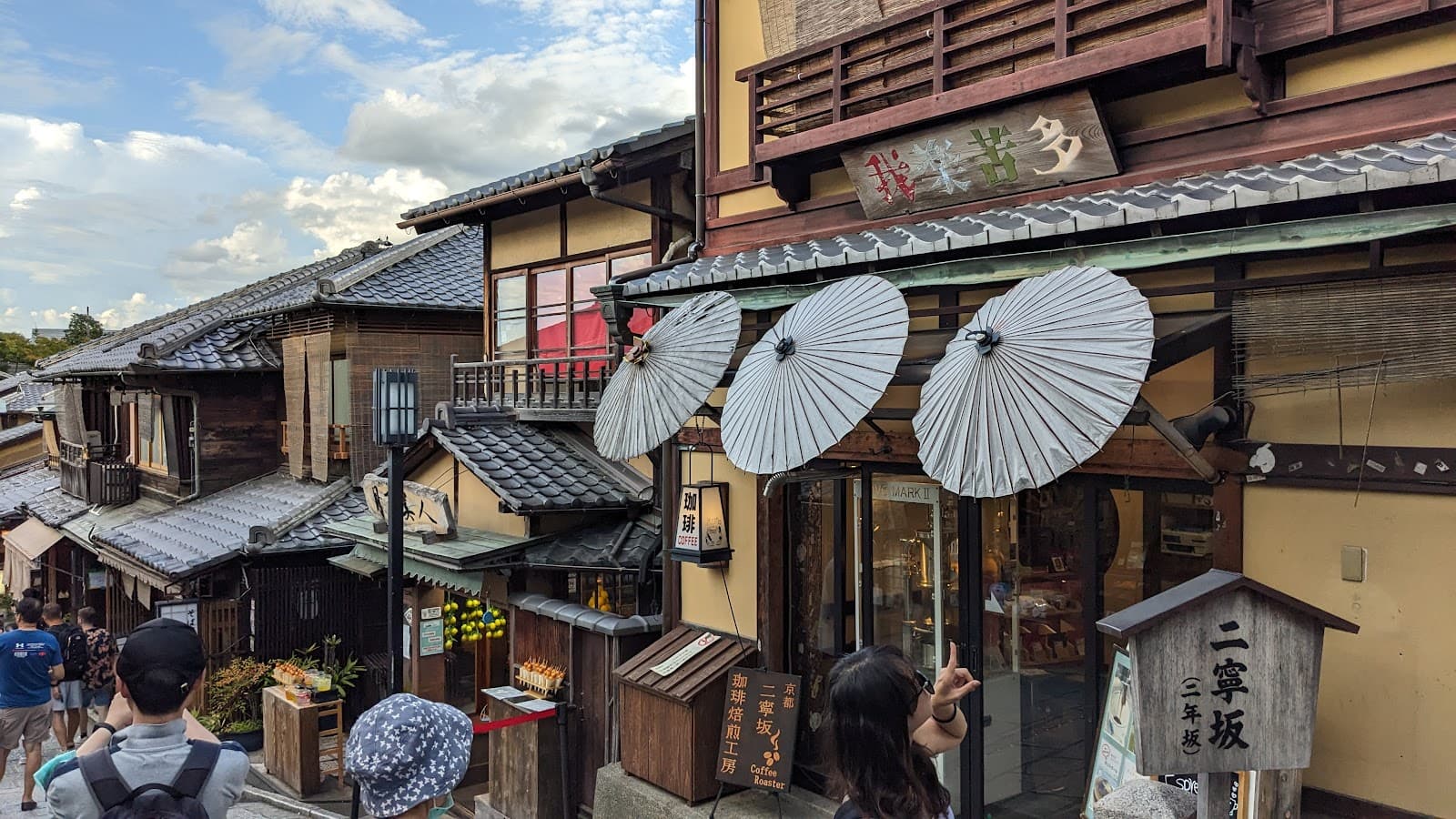
These stone-paved lanes climbing the hillside form Kyoto's most photographed streets. The names translate as "Two-Year Slope" and "Three-Year Slope", referring to the Daido period years when they were constructed (around 808 CE).
Traditional machiya townhouses line both sides, converted into cafés, craft shops, and restaurants. Tsujiri Sannenzaka serves matcha parfaits (¥1,200) and operates a small museum of tea ceremony utensils upstairs (free). For lunch, Kasagiya serves soba noodles in a 100-year-old house (¥1,000-1,500, closed Thursdays).
Local legend claims that stumbling on Sannenzaka brings bad luck for three years. Watch your footing - the stones can be slippery after rain.
This area gets extremely crowded between 11:00am and 4:00pm, especially on weekends and during cherry blossom or autumn foliage seasons. If you started early at Ginkaku-ji, you should arrive here by early afternoon, ahead of the peak crowds.
Allow 30-45 minutes to walk these lanes, longer if you stop frequently for photos or shopping.
Kiyomizu-dera
The stone slopes deliver you to Kiyomizu-dera's main gate. This temple, founded in 778 CE, clings to the hillside above the city. The name means "Pure Water Temple", referring to the Otowa waterfall that flows beneath the main hall.
The wooden terrace projecting from the main hall stands 13 metres above the hillside, supported by 139 pillars, assembled without nails using a technique called kasezukuri. The current structure dates from 1633. Standing on this terrace offers panoramic views across Kyoto - cherry blossoms in spring, green forests in summer, crimson maples in autumn, and snow-dusted temples in winter.
Entry costs ¥400. The three-storied pagoda and several sub-halls require additional fees if you wish to enter (¥100-300 each).
At the Otowa waterfall, three streams pour into a pool. Visitors use long-handled ladles to catch water from their chosen stream - one represents longevity, one academic success, one romantic fortune. Drinking from all three is considered greedy.
Kiyomizu-dera opens at 6:00am and closes at 18:00 most of the year, with extended hours during special illuminations. Night visits (¥400) run during spring, summer, and autumn peak seasons, typically 18:30-21:30.
Allow one to one and a half hours for a complete visit.
Practical Notes
This entire walk covers approximately 6 kilometres. With temple visits, you'll spend four to five hours on the route. Starting at 8:30am (when Ginkaku-ji opens) means you'll finish around 1:00-2:00pm, avoiding the worst afternoon crowds at Kiyomizu-dera.
Wear comfortable, broken-in walking shoes. You'll climb roughly 300 steps throughout the day, mostly on the final approach to Kiyomizu-dera. Several sections use uneven stone paving.
Bring water - vending machines appear regularly along the route, but having your own bottle is sensible. Small restaurants and cafés cluster around each major temple, so finding food presents no difficulty.
For public toilets, use the facilities at Ginkaku-ji, Nanzen-ji, Maruyama Park, or Kiyomizu-dera. The temples maintain them to high standards.
Getting Back
From Kiyomizu-dera, walk down Kiyomizu-zaka (the main approach street) to reach Gojo-zaka bus stop. Multiple routes serve this stop:
- Bus 100 or 206 to Kyoto Station (¥230, 15-20 minutes)
- Bus 207 to Shijo-Kawaramachi (downtown shopping district)
- Walking to Kiyomizu-Gojo Station (Keihan Line) takes 12 minutes
Alternatively, continue west from the temple for 15 minutes to reach Gion, Kyoto's geisha district, where you can explore further or find dinner options.
Best Times to Walk This Route
Cherry blossom season (late March to early April) transforms the Philosopher's Path into a pink tunnel. Expect larger crowds but spectacular views.
Autumn (mid-November to early December) brings out Kyoto's famous maple colours. Eikan-do becomes particularly stunning. Book accommodations well in advance during this period.
Early summer (June) means hydrangeas blooming along the Philosopher's Path and fresh green maples on the hillsides. Occasional rain showers occur, but crowds thin out.
Winter (January-February) offers the quietest experience. Occasional snow dusts the temples, creating postcard scenes. The Philosopher's Path becomes less attractive without foliage, but temple gardens maintain their beauty year-round.
This walking route reveals Kyoto's layers - ancient temples, philosophical traditions, preserved streetscapes, and natural beauty changing with the seasons. Taking the path on foot, rather than hopping between attractions by bus, lets you discover the small temples, quiet gardens, and neighbourhood details that truly define this city.