
 By Declan Barry
Naoshima gets the art-world attention, and rightly so - but the Seto Inland Sea has two larger islands that reward a different kind of visit. Shodoshima suits travellers who want scenery, food culture, and a slower pace without gallery queuing. Awaji Island suits those coming from Kobe or Osaka who want dramatic coastal views and easy self-drive access. Neither is a substitute for the other, and neither is a substitute for Naoshima - but both earn a place on a Setouchi itinerary in their own right.
Awaji Island
Awaji Island
Island with temples & 2 suspension bridges, considered the birthplace of Japanese puppet theater.
Open in Maps ↗Shodoshima: Olives, Gorges, and Soy Sauce
Shodoshima (小豆島, pronounced "show-doh-shee-ma") is Kagawa Prefecture's second-largest island, sitting roughly in the middle of the Inland Sea between Takamatsu and Himeji. At about 153 square kilometres, it takes at least two days to cover properly. The island is best known domestically for three things: Japan's oldest olive cultivation, the soy sauce and sesame oil industries still operating in small traditional breweries, and Kankakei Gorge, one of Japan's three official "great gorges".
Getting to Shodoshima
The most useful crossing is Takamatsu to Tonosho Port - operated by Shodoshima Ferry and Jumbo Ferry. The Jumbo Ferry takes about 60 minutes and costs roughly ¥700 per adult (foot passenger). Car ferries are also available if you plan to self-drive the island, which is by far the most practical way to get around.
From Osaka/Himeji, a Shin-Okayama Port ferry runs to Tonosho in about 70 minutes (around ¥1,700). From Okayama, you take the JR Ako Line to Hinase or a bus to Shin-Okayama Port first - check Shodoshima Ferry's timetable before travel as schedules change seasonally.
Ferry bookings for peak periods (Golden Week, August, autumn colour season in October and November) fill quickly. Book the car ferry slot at least a week ahead through the Shodoshima Ferry website.
Getting Around Shodoshima
Shodoshima has buses, but they run infrequently - some routes run just two or three times a day. A rental car from Tonosho Port (available from several operators near the terminal, roughly ¥5,000-¥7,000 per day for a standard car) is the sensible choice for anything beyond the immediate port area. Scooter hire is available for solo travellers comfortable on unfamiliar roads.
If you are relying on buses, plan around them precisely. The Olive Bus connects major attractions but on a limited timetable.
Kankakei Gorge and Ropeway
Kankakei is the island's centrepiece. The gorge itself is a 30-million-year-old collapsed volcanic crater, with sheer rock faces up to 800 metres above sea level covered in maple and oak. The Kankakei Ropeway (rated 4.2★ in our database) runs from Kountei Station at the base to the ridge above - a four-minute ride that saves a steep uphill hike. The ropeway costs ¥1,400 return for adults.
Shodoshima
Kankakei Ropeway
National park with a lush ravine offering sweeping cablecar views, hiking trails & dense foliage.
Open in Maps ↗At the top, the Kankakei Ropeway Kountei Station (4.3★) area connects to walking trails. The 30-minute loop to the summit viewpoint passes a series of named rock formations, the most visited being Kasaneiwa (4.6★) - a stack of large boulders balanced on a ridge with a rope-and-chain scramble to reach the top. The drop on either side is significant; take it seriously if you have young children or are unsteady on uneven rock. The 360-degree view of the Inland Sea on a clear day is the payoff.
Shodoshima
Kasaneiwa
Landmark stacked boulders with sweeping sea views, reached by a steep path with stairs & ropes.
Open in Maps ↗Autumn (mid-October to mid-November) brings crowds to Kankakei for the maple colour, which can be genuinely spectacular but also means the ropeway queues run long on weekends. Weekday mornings are quieter.
Shodoshima Olive Park and the Greek Windmill
Japan's first olive trees were planted on Shodoshima in 1908, and the island now supplies a significant share of Japan's domestic olive oil. Shodoshima Olive Park (4.2★) is built around those original groves and has become one of the island's most-visited spots - partly for the olives themselves, partly for the white Greek Windmill (4.3★) that sits on the hill above the terraced grounds.
Shodoshima
Shodoshima Olive Park
Mediterranean style park & olive grove with a Greek windmill, museum, restaurants & gift shop.
Open in Maps ↗The park entry is free. The windmill has featured in several popular photographs on Japanese social media - visitors can borrow brooms from the park gift shop to recreate a scene from the Studio Ghibli-inspired rental shop outside. This is firmly in "it's fun if you lean into it" territory rather than something to judge from the outside.
The park's restaurant serves olive oil-forward dishes using Shodoshima produce. The gift shop sells genuine local olive oil at prices well below what you would pay for equivalent quality in Takamatsu or Tokyo.
Angel Road
Angel Road (4.2★) is a sandbar that connects Shodoshima's western coast to a small chain of islands at low tide. At high tide it disappears. The walk across takes about ten minutes and is completely flat - bring something waterproof for your feet if the tide is on the way in or out, as the edges get wet. The surrounding bay is quiet, with fishing boats moored just offshore.
The "legend" attached is that couples who walk it while holding hands will have their wishes granted. This is primarily a domestic romantic spot rather than something marketed heavily to international visitors. Low-tide timing varies by day - check a tide chart before planning your visit. The tourist information at Tonosho Port prints daily tide times.
Soy Sauce and Sesame Oil Breweries
The Shozu soy sauce tradition dates back about 400 years. Several small producers still operate in the island's interior, and the area around Kusakabe has a cluster of old brewery buildings. Marukin Soy Sauce, the largest producer, has a museum (¥200 entry) with tasting and a working wooden barrel visible from the viewing platform. The smell of fermenting soy in the surrounding lanes is distinctive and not unpleasant.
Shodoshima is also one of Japan's few remaining producers of sesame oil using traditional stone pressing. Yamaroku Soy Sauce, a smaller producer, uses 100-year-old cedar barrels (kioke) and occasionally allows visitors into the brewery - check their website before visiting as access is not guaranteed.
Nakayama Terraced Rice Fields
In the island's upland interior, Nakayama Terraced Rice Fields (4.1★) cover a hillside with hundreds of small hand-cultivated paddies fed by spring water. They are best visited in summer (June to August) when the paddies are green, or in early autumn (September to October) when they turn gold before harvest. In late October the rice is cut and the fields are quieter. This is a 15-minute drive from Tonosho; the access road is narrow.
Awaji Island: Coast, Flowers, and the Naruto Whirlpools
Awaji Island (淡路島) is the largest island in the Inland Sea at around 592 square kilometres - large enough to have its own expressway and to take a full day to circuit by car. Administratively part of Hyogo Prefecture, it sits between Kobe and Tokushima, connected to both by suspension bridges. Most visitors arrive from Kobe, which is the straightforward option.
Getting to Awaji Island
From Kobe, Awaji is reached via the Akashi Kaikyo Bridge - the longest suspension bridge in the world at 3,911 metres. By car, it is about 30 minutes from Kobe's Tarumi area to the northern tip of Awaji via the Kobe-Awaji-Naruto Expressway. The toll from Maiko to Awaji IC is around ¥1,220 for a standard car (check the NEXCO rate calculator for current prices).
No train crosses to Awaji. Bus is the public transport option: Honshi Bus (本四バス) runs from Sannomiya Station in Kobe to Sumoto (the island's main city) in about 55 minutes for roughly ¥1,880. From Osaka's Namba or Umeda, Hankyu Bus and JR Bus run to Sumoto in approximately 1 hour 40 minutes. Check Kosoku Bus (高速バス) booking sites for current schedules.
Without a rental car, your movement around Awaji is limited. Buses connect major stops, but infrequently. Hiring a car at Sumoto Bus Centre or the Awaji IC area is the most practical approach.
Hanasajiki Flower Fields
On the island's north-western hillside overlooking the Akashi Strait, Hanasajiki (花さじき) is a 15-hectare public flower park managed by Hyogo Prefecture. Entry is free. The planting rotates through the year: poppies and larkspur in May, sunflowers in July and August, cosmos in September and October. It is not a manicured botanical garden - it is a working hillside display that rewards a short walk uphill for the view across to Kobe and the Akashi Kaikyo Bridge.
This is one of the better-value stops on Awaji precisely because there is nothing to pay and the view has genuine scale. Parking costs ¥500. Go on a weekday morning to have the hillside largely to yourself.
The Naruto Whirlpools
The Naruto Strait, between the southern tip of Awaji and Tokushima's Naruto coast, is one of the few places in Japan where tidal whirlpools are large enough to be worth travelling to see. The diameter of the biggest whirlpools reaches 20 metres during spring tides (March to April and September to October are the peak months). They form as the tide changes direction, roughly four times per day.
You have two viewing options from the Awaji side:
Uzushio cruise - Naruto Kisen runs boats from Fukura Port on Awaji's southern tip directly into the Naruto Strait. Adult tickets cost ¥2,600 for the 30-minute cruise. Being on the water during a strong tide is genuinely loud and disorienting in a way that standing on the bridge walkway is not. Book in advance during spring and autumn.
Ohnaruto Bridge walkway (Uzu no Michi) - The bridge has a glass-floored walkway 45 metres above the water. Entry is ¥510 (adults). You look directly down at the whirlpools as they form. The glass sections are smaller than expected but the drop view is clear.
Whirlpool timing varies by day and by the lunar calendar. Check the Naruto Kisen website or the Naruto City tourism page for the day's strongest tide times before booking your cruise.
Izanagi Shrine
Awaji's most historically significant site is Izanagi Shrine (Izanagi Jingu), located near Ichinomiya on the island's north-eastern coast. In the Kojiki and Nihon Shoki - Japan's oldest written records - Awaji is identified as the first island created by the gods Izanagi and Izanami, and this shrine is dedicated to Izanagi. The main hall sits in a cedar grove, quiet most mornings except during major festivals. Entry is free.
This is not a site that stages itself for photographs. The appeal is in its age and the specific Shinto cosmology it represents - Japan's creation myth is anchored here, and the setting reflects that without theatrics.
Onokorojima Shrine
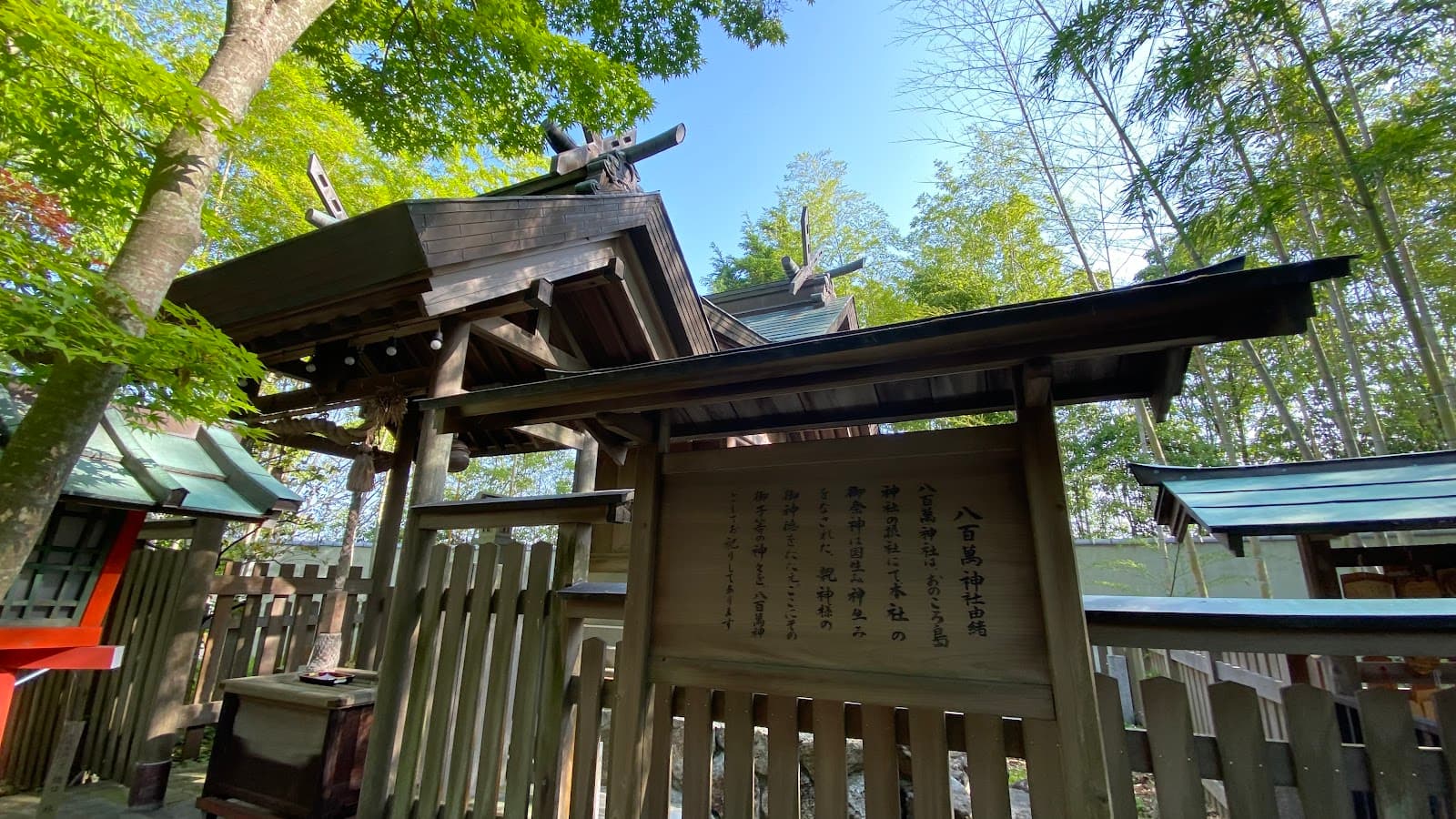
Onokorojima Shrine (4.1★) is a separate site near Ichinomiya with a striking large torii gate visible from the surrounding rice paddies. It is a small hilltop shrine, and the approach through the paddies is quieter and more photogenic than many more-visited shrine approaches. Worth 30 minutes if you are in the northern part of the island.
Sumoto Castle Ruins
Sumoto Castle Ruins (4.0★) occupy a rocky crag above the island's main city. The stone foundations and some reconstructed sections survive from the 16th century. The climb takes about 15 minutes from the car park and gives a clear view over Sumoto Bay. It is not a full museum experience - this is a ruin, and is best for people who appreciate site archaeology and local history rather than for those expecting a complete castle interior.
Wellness Park Goshiki
For visitors who want to slow down, Wellness Park Goshiki (4.1★) on the island's western coast has onsen facilities and accommodation in log cabins, plus sea views from the bath. Day-use onsen access is available for around ¥700-¥900. The surrounding Goshiki area is one of Awaji's quieter coastal stretches.
Shodoshima vs. Awaji: Who Each Island Suits
Choose Shodoshima if you are travelling from Takamatsu or Okayama, you want to combine with a Naoshima visit (both are accessible from Takamatsu), you prefer to spend two or more days on a single island at a slow pace, and you are drawn to food culture, gorge hiking, or traditional craft industries.
Choose Awaji if you are based in Kobe or Osaka and want an easy day trip or one-night stay, you have a rental car (the island is built for driving), and you want coastal scenery and the Naruto whirlpools without ferry logistics.
The honest trade-off: Shodoshima requires more planning - ferries, timetables, accommodation booked in advance during peak seasons. Awaji is easier to reach but feels more like a regional leisure island aimed at Kansai day-trippers; it lacks Shodoshima's distinctive food identity and the gorge landscape.
If you are combining either with Naoshima, Takamatsu is the most useful hub - ferries to both Naoshima and Shodoshima run from there, and the city itself is worth a half-day for Ritsurin Garden and the udon scene.
Practical Summary
| Shodoshima | Awaji Island | |
|---|---|---|
| Best base | Takamatsu or Okayama | Kobe or Osaka |
| Getting there | Ferry, 60-70 min | Car or bus via Akashi Kaikyo Bridge |
| Getting around | Rental car essential | Rental car strongly recommended |
| Minimum time | 2 days | 1 day (full circuit) |
| Peak crowds | Oct-Nov (autumn colour), Aug | Golden Week, July-Aug |
| Best for | Food culture, hiking, scenery | Coastal drives, Naruto whirlpools |
Ferry prices and schedules change seasonally. Confirm all crossings with the relevant ferry operator website before your trip.