
 By Declan Barry
Yudanaka and Shibu Onsen are two small hot-spring villages in Nagano Prefecture that most visitors treat as a quick detour for the Jigokudani snow monkeys before heading back to the city. That is worth correcting. The area has its own distinct character: a row of wooden ryokan along a single lantern-lit street, nine public bathhouses you can work through one by one, and a pace that sits well outside the Nagano tourist circuit. This guide focuses on the villages themselves, the bathhouse-hopping tradition, staying overnight, and how to use the area as a base across any season.
Getting Here from Nagano
The straightforward option is the Nagano Dentetsu Line from Nagano Station to Yudanaka Station. The journey takes roughly 40 minutes and costs around ¥1,230 one-way. Trains run roughly every 30 minutes during the day. Buy the ticket at the Nagano Dentetsu ticket window on the basement level of Nagano Station, underneath the main Shinkansen concourse - it is a separate operation from JR, so a JR Pass does not cover it.
From Yudanaka Station it is about a 10-minute taxi ride up the valley to Shibu Onsen (roughly ¥1,000-¥1,200). There is also an infrequent local bus if you time it. The station itself has a foot bath just outside the exit - the Yudanaka Station Front Kaede Hot Spring (4.1★) - which is a useful first test of the water and a good place to wait if your ryokan check-in is still an hour away.
By car from Nagano it is around 30-40 minutes on Route 292, which also connects to Shiga Kogen further up the mountain. This route is sometimes affected by snow closures in winter, so check conditions between December and March.
Yudanaka
Shiga Kogen
Acclaimed collection of ski resorts with 71 lifts & the site of many 1998 Nagano Olympic sports.
Open in Maps ↗Shibu Onsen: The Street and the Nine Baths
Shibu Onsen is smaller than Yudanaka and the more photogenic of the two - one main cobbled street, traditional wooden facades, steam rising from the drains. The village has been channelling water from the same volcanic sources for over 1,300 years, and the infrastructure shows it: pipes rust, stone channels drip, and the buildings lean against each other without apology.
The bathhouse-hopping tradition here is specific. There are nine public bathhouses (called Soto-yu, or external baths) numbered from Ichi-no-yu through to Ku-no-yu. They are open exclusively to guests staying in a registered Shibu Onsen ryokan - not to day-trippers. When you check in, your inn gives you a wooden key that fits the padlocks on all nine bathhouses. The idea is to visit all nine over your stay and stamp your towel or card at each one.
This is not a gimmick layered on top of the bathing culture - it is the bathing culture. Each bathhouse has a different water composition, temperature, and character. Ichi-no-yu is small and very hot. Shichi-no-yu (number seven) has a stronger sulphur note. Ku-no-yu, at the far end of the street, is usually the quietest in the early morning. Most of them hold four to six people at most. Going at 06:00 or 07:00 means you will often have a bath entirely to yourself.
For practical context on etiquette and what to bring to a public bath, the site's existing guide on onsen etiquette covers the first-timer walkthrough in detail - no need to repeat it here.
Staying in a Ryokan: What This Specific Area Offers
Accommodation in Shibu Onsen is almost entirely ryokan. There are roughly a dozen inns on the main street and a handful more on the lanes off it. Prices typically start around ¥18,000-¥25,000 per person per night with two meals (dinner and breakfast), which is mid-range for a ryokan with onsen access. Rooms vary: some have their own small private bath, most share communal baths within the building.
The two-meals system matters here. Dinner at a Shibu Onsen ryokan usually arrives as kaiseki - a set of seasonal small dishes spread across your low table, served in the room or in a communal dining area. Portions are calibrated and the pacing is slow by design. Breakfast follows the same pattern. If you are used to eating dinner at 20:00 or later, the 18:00-18:30 typical service window is worth noting when you book.
Yudanaka town itself, five minutes downhill by taxi, has slightly cheaper accommodation options including a few guesthouses and smaller inns with more flexible meal arrangements. The trade-off is that Yudanaka does not give you the nine-bath key. If the bathhouse-hopping is your reason for coming, stay in Shibu. If budget is the primary concern, Yudanaka is a reasonable base.
The site's existing guide on onsen ryokan covers what makes a hot-spring inn structurally different from a standard hotel, and the ryokan arrival etiquette piece handles check-in customs - both worth reading before you arrive.
The Jigokudani Monkey Park: How It Fits In
Jigokudani Monkey Park (4.5★) is a 30-35 minute bus ride from Yudanaka Station, followed by a 1.6-kilometre walk on a forest path through cedar and snow. The monkeys bathe in the onsen pool throughout the year, though winter visits between December and March give you the best chance of seeing them actually in the water rather than just nearby. Entrance is ¥800 for adults.
Yudanaka
Jigokudani Monkey Park
Destination for up-close viewing of snow monkeys in a secluded park accessible by long, scenic walk.
Open in Maps ↗For a full practical breakdown of the snow monkey visit, including the specific bus to take and the best time of day to go, the site's dedicated article on a winter day trip to Jigokudani from Nagano covers it in detail - no need to duplicate that here. The key point for this guide is that the monkey park fits comfortably into the morning of your first or last day. Arrive at Yudanaka, take the bus up to Jigokudani, walk the path, watch the monkeys for an hour, and be back in Shibu Onsen by early afternoon with the rest of the day free for bathing and the village street.
Beyond the Single Hot-Spring Visit: The Area Across Seasons
Spring and Early Summer
The valley floor between Yudanaka and Shibu gets quiet between April and June. Cherry blossom arrives in Yudanaka around mid-April, slightly later than Nagano city. Ippongi Park (4.2★), a short distance from the main tourist area, has hundreds of rose varieties that bloom from late May into mid-June - it is a specific reason to visit outside the ski and snow-monkey window, and the park draws far fewer visitors than the winter months.
Yudanaka
Ippongi Park
Hundreds of varieties of roses bloom late May to mid June at this scenic park with a playground.
Open in Maps ↗Gansho-in (4.4★) is a temple in the valley that houses a large ceiling painting of a mythical phoenix-like bird completed in 1848 by Katsushika Hokusai - one of his final works. The painting covers roughly 21 square metres. Most people visiting Yudanaka skip it entirely in favour of the monkey park. Entrance is ¥500. Allow 30-40 minutes.
Yudanaka
Gansho-in
Popular, picturesque temple with a famed 1848 mythical bird painting by Katsushika Hokusai.
Open in Maps ↗Summer
Shiga Kogen (4.5★), the large ski plateau above the valley, transforms in summer into walking and cycling terrain. The plateau sits at 1,500-2,000 metres elevation and is noticeably cooler than Nagano city in July and August - a genuine practical reason to come up here in the heat. The road from Yudanaka to Shiga Kogen takes around 20-30 minutes by bus.
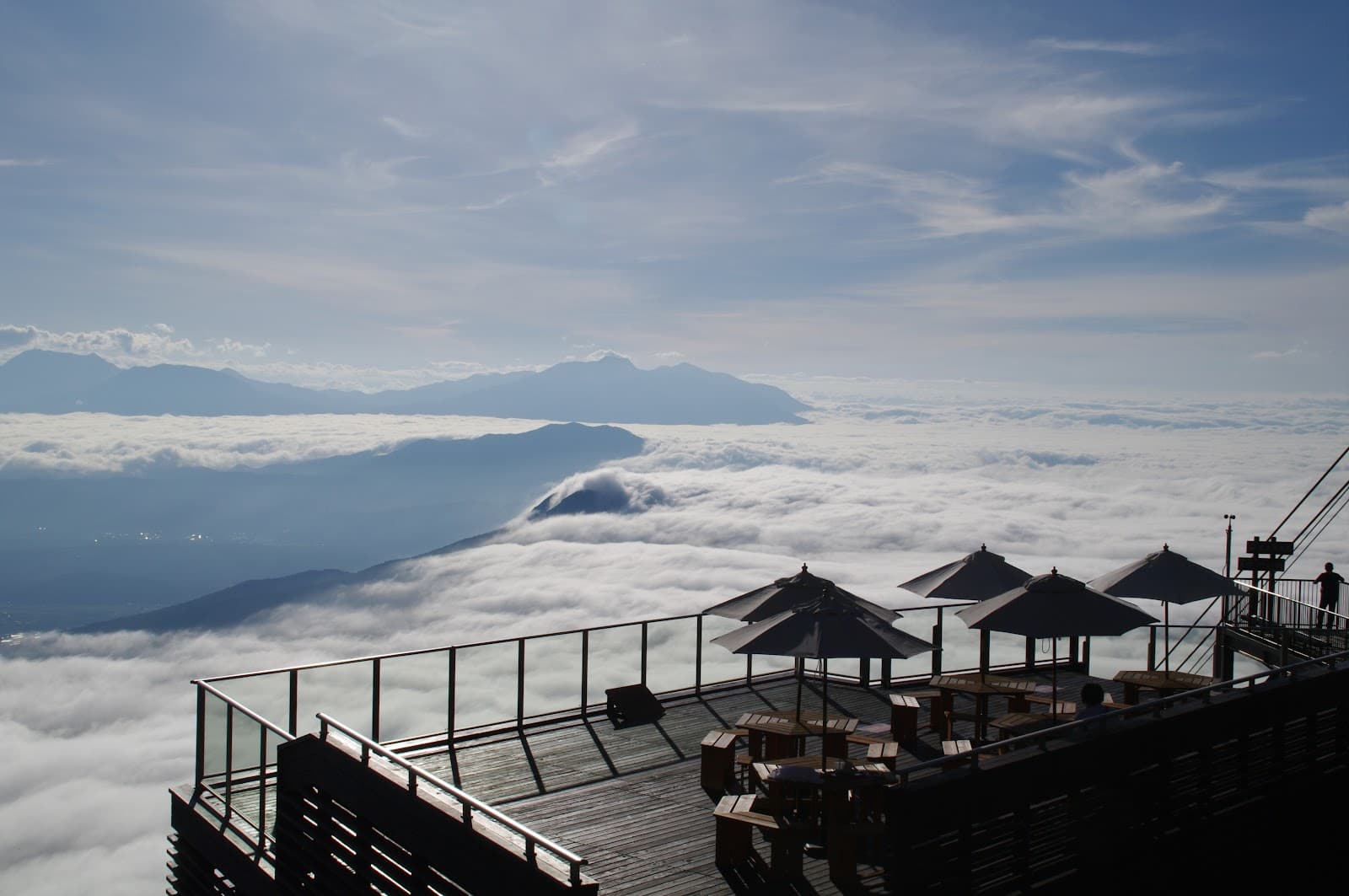
The SORA Terrace (4.1★) at the top of the Yamanouchi gondola is a mountaintop café open in both summer and winter. On clear days it has wide views across the Shiga Kogen plateau with seats indoors and out. It is not a destination in itself but combines well with a half-day on the plateau.
Yudanaka
SORA terraceSORA terrace
Spacious mountaintop cafe with big picture windows, plus outdoor seats surrounded by clouds.
Open in Maps ↗Autumn
Foliage on the Shiga Kogen plateau typically peaks in early-to-mid October, several weeks ahead of Nagano city and Kyoto. The route between Yudanaka and the plateau turns amber and deep red and is arguably when the area looks its most distinct. Ryokan rates can rise slightly at this time, so booking two to three months ahead is practical advice.
Winter
Winter (December to March) is the busiest season, driven by the snow monkey park and by Shiga Kogen's ski resorts. Shiga Kogen (4.5★) hosted multiple events during the 1998 Nagano Winter Olympics and remains one of Japan's largest interconnected ski areas, with 71 lifts. The Shigakogen Takamagahara Mammoth Ski Area (4.1★) is one of the main complexes within Shiga Kogen, with downhill and back-country runs. For non-skiers, the village in winter has a particular character: deep snow, quiet side streets, steam visible across rooftops, and the nine baths even more inviting at -5°C.
One caveat for winter visits: the buses between Yudanaka and Jigokudani can be crowded on weekends and during the January-February peak. The village itself sees more foot traffic on those days. Arriving on a weekday and staying at least two nights distributes the crowd impact.
Practical Notes
Timing your arrival. Ryokan check-in is typically 15:00-16:00. If your train arrives earlier, the foot bath at Yudanaka Station Front Kaede Hot Spring is a useful stop before heading up to Shibu. There is also a small tourist information point and the Snow Monkey Resorts Info & Gift Shop (4.1★) near the station for bus schedules and local maps.
What to bring. Most ryokan provide yukata (cotton robe), towels, and toiletries. For the external Soto-yu bathhouses in Shibu, you carry a small towel with you - your inn supplies one for this. Bring a bag or small tote to carry the stamp card if you want to complete all nine baths.
Day visitors and the nine baths. It is worth repeating: the nine external bathhouses in Shibu Onsen are not accessible to day visitors. You must be a registered guest at one of the participating ryokan. Day visitors can use some facilities at Yudanaka Onsen and a handful of publicly accessible baths in the broader area, but the Shibu Soto-yu system is specifically tied to an overnight stay.
Access for people with tattoos. The communal baths at most ryokan in this area follow the standard onsen policy: tattoos are not permitted in shared facilities. Some inns have private baths (kashikiri onsen) that can be booked by the hour - ask when reserving if this is relevant to you.
Getting back. The last Nagano Dentetsu train from Yudanaka to Nagano runs around 21:20-21:30. Check the timetable on the day as it varies slightly by season. If you miss it, a taxi to Nagano costs around ¥10,000-¥12,000.
Who This Area Suits
Yudanaka and Shibu Onsen work best for travellers who want more than a single onsen dip and a selfie with a monkey. The bathhouse-hopping ritual, the ryokan dinner pacing, and the small-town quiet between baths all require a certain willingness to slow down. Two nights is the minimum to feel the rhythm of the place rather than just passing through it.
For skiers, it doubles as a convenient, character-filled base for Shiga Kogen - warmer and more interesting than staying in a ski lodge at altitude. For non-skiers in winter, the snow and village atmosphere are genuine without requiring you to go near a slope.
If your priority is the snow monkeys specifically and you are not planning to stay overnight, the day-trip guide from Nagano covers that route more efficiently than basing yourself here would.