
 By Declan Barry
Ouchi-juku is a former Edo-period post station in the mountains of Fukushima Prefecture where roughly 30 thatched-roof buildings survive in active use along a single gravel street. It takes the best part of a day from Tokyo and requires a train change onto a local line plus a taxi or infrequent bus, but the combination of preserved architecture, a genuinely odd local dish, and a February snow festival makes it a different proposition from the more-visited post towns on the Nakasendo.
Ouchi-juku
Ouchi-juku
Preserved post town featuring thatched-roof Edo-period buildings along its main street.
Open in Maps ↗What Ouchi-juku Actually Is
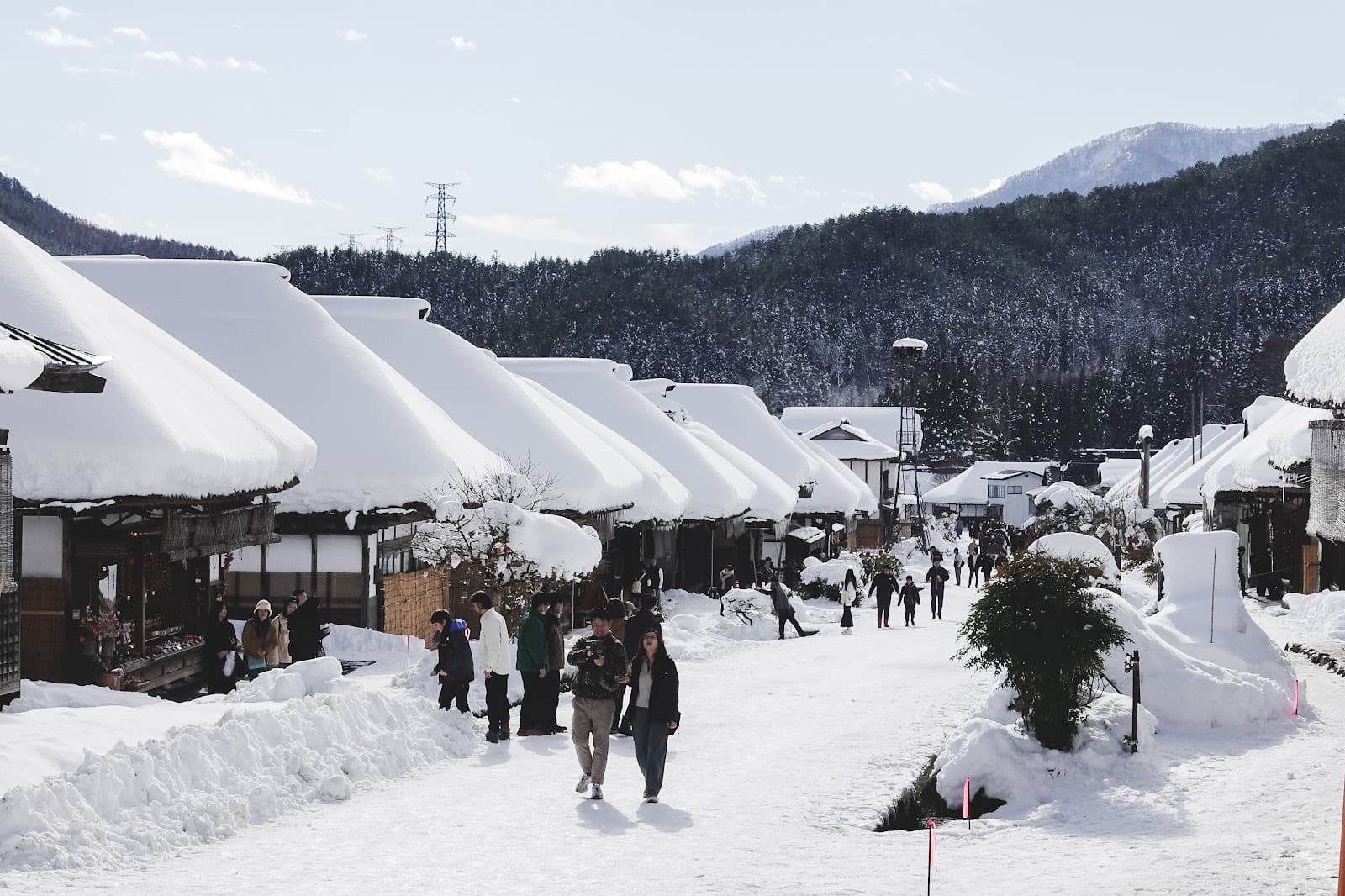
During the Edo period (1603-1868), Ouchi-juku sat on the Aizu-Nishi Kaido, a secondary highway connecting Aizu-Wakamatsu to Nikko. Travellers and officials stopped here to rest, eat, and change horses. The buildings that remain are not a museum set: most are family-run restaurants and guesthouses occupying original or faithfully rebuilt structures. The street itself is unpaved, about 500 metres long, and lined on both sides with steeply thatched houses set back from a shallow drainage channel.
The town draws roughly 800,000 visitors a year, which sounds busy, but unlike Kyoto's preserved streets the crowds are concentrated into specific windows. Most day-trippers arrive between 10:00 and 14:00 on weekends in late April and November. Arrive before 9:30 or stay past 15:00 and the main street is genuinely quiet.
Getting There from Tokyo
Ouchi-juku has no direct rail connection. The route breaks into two legs.
Leg 1 - Tokyo to Aizu-Wakamatsu: Take the Tohoku Shinkansen from Tokyo Station north to Koriyama (about 70 minutes, ¥6,680 on a free-seat ticket). At Koriyama, transfer to the Ban-Etsu West Line (Banetsu-Saisen) for Aizu-Wakamatsu. That journey takes around 90 minutes and costs approximately ¥1,170. Total Shinkansen plus local train: allow around 3 hours and budget roughly ¥7,850. Trains run hourly from Koriyama.
Alternatively, the Aizu Liner express service runs a direct limited-express from Koriyama to Aizu-Wakamatsu in about 65 minutes on some timetable slots - check the JR East timetable on the day.
Leg 2 - Aizu-Wakamatsu to Ouchi-juku: From Aizu-Wakamatsu, take the Aizu Railway (a private line, so IC cards and JR passes are not valid) from Aizu-Wakamatsu Station to Yunokami Onsen Station. The ride is 40 minutes and costs ¥820. Trains run roughly every 1-2 hours, so check the Aizu Railway timetable before you leave Koriyama. From Yunokami Onsen Station, Ouchi-juku is 3 kilometres by road. A taxi from the station rank takes about 7 minutes and costs around ¥1,200-¥1,500. There is a community bus on some days, but it is infrequent enough that a taxi is the practical option for most travellers.
Total journey from Tokyo: roughly 3.5 to 4 hours door to door, depending on connections.
JR Pass note: The Shinkansen and Ban-Etsu West Line are JR services and are covered by the JR Pass. The Aizu Railway section from Aizu-Wakamatsu to Yunokami Onsen is not.
The Main Street and Ouchi-juku View Point
The preserved street - Ouchi-juku itself (4.2★) - runs north to south with mountains visible at both ends. Walk the full length before you stop anywhere: the rhythm of the buildings is better appreciated when you see the whole street first rather than ducking into the first shop. The southern end is where most visitors enter; the northern end is quieter and the eaves are lower, giving a better sense of the original scale.
At the northern end, a stone staircase climbs through cedars to the Ouchi-juku View Point (4.5★), a small raised platform with a clear line of sight down the entire street. This is the shot that appears on every poster of Ouchi-juku, and it earns its reputation practically rather than aesthetically: from up here you can see how uniformly the thatch has been maintained and how the street sits in a narrow river valley with forested ridges on three sides. The climb takes about 5 minutes. There is no entrance fee for either the street or the viewpoint.
One detail most visitors miss: look at the individual thatched roofs closely. Each is around 40-50 centimetres thick at the ridge and is re-thatched on a rotation of roughly 20-30 years. The colour variation between buildings, from pale gold to dark brown, reflects where each house sits in that cycle.
Negi Soba: Eating with a Spring Onion
The dish associated with Ouchi-juku is negi soba, a bowl of buckwheat noodles served with a whole spring onion (negi) resting across the bowl in place of chopsticks. You eat by biting off sections of the onion and using it to scoop noodles. The onion is sharp and pungent; the soba is generally handmade and served cold on a lacquer tray in summer and warm in a broth in winter.
The origin story is debated, but the practice appears to be a relatively recent local invention rather than an Edo-period custom. That said, it is specific to this town and worth trying on its own terms. Several restaurants on the main street serve it. Expect to pay ¥1,100-¥1,500 per bowl. Misawaya is one of the older family restaurants on the street; Yoshinoya (not the chain) is another frequently recommended option. Arrive before 11:30 to avoid queuing during peak weekends.
The Ouchi-juku Snow Festival (February)
On the second weekend of February each year, Ouchi-juku holds a snow festival called Yuki-matsuri. The street is lined with snow lanterns and small candles, and the thatched roofs carry a heavy covering of winter snow. Evening illuminations run from around 17:30 to 21:00 on both the Saturday and Sunday of the festival weekend.
This is genuinely one of the better reasons to make the journey from Tokyo: the combination of lit snow lanterns, the thatched roofs under snow, and the relative warmth of the restaurants makes the cold worthwhile. That said, February is the coldest month in this part of Fukushima, with temperatures regularly below -5°C at night. Wear proper winter layers and waterproof boots; the gravel street becomes compacted snow and ice.
Book accommodation in Aizu-Wakamatsu well in advance for festival weekend. Rooms inside Ouchi-juku itself (guesthouses within the old buildings) are limited to a handful of establishments and sell out months ahead.
To-no-Hetsuri: The River Cliffs Nearby
If you are combining Ouchi-juku with a second stop, To-no-Hetsuri is the most practical option. The site is a 100-metre stretch of volcanic rock cliffs above the Okawa River, carved over roughly 100,000 years of erosion into shapes that have been compared to towers and castle parapets. A suspension bridge crosses to a small Benzaiten shrine on a rock outcrop.
To-no-Hetsuri has its own station on the Aizu Railway: Tonohetsuriguchi Station, about 10 minutes from Yunokami Onsen by train (¥260). The cliffs are a short walk from the station and entrance is free. The most practical order if coming from Tokyo is to stop at To-no-Hetsuri on the way in (alight at Tonohetsuriguchi, spend 45-60 minutes, reboard toward Yunokami Onsen) and then continue to Ouchi-juku.
Autumn (late October to mid-November) is the clearest season here: the maple and beech trees above the cliffs turn red and orange against the grey rock. In summer the cliffs are green with moss and ferns, which is quieter but less visually distinct.
Yunokami Onsen Station: Worth the 5-Minute Walk
Yunokami Onsen Station is the Aizu Railway stop you pass through to reach Ouchi-juku, and it is worth a deliberate pause rather than a taxi dash. The station building is a small thatched structure, one of very few thatched railway stations remaining in Japan, and sits beside a footbath (ashiyu) fed by the local hot spring. The footbath is free and open year-round.
The onsen village itself is a short walk from the station, with around a dozen small ryokan and day-use bath facilities. If you are staying overnight in the area, Yunokami Onsen is a more comfortable base than sleeping on the Ouchi-juku main street: the ryokan are better equipped, the baths are good, and the taxi to Ouchi-juku takes 7 minutes. Expect ryokan rates of around ¥12,000-¥18,000 per person per night including dinner and breakfast.
Practical Notes
Best seasons: Late April (fresh greenery, post-sakura quiet), late October to mid-November (autumn colour on the surrounding hills), and February festival weekend. Avoid Golden Week (late April to early May) unless you arrive very early: the street becomes genuinely crowded between 10:00 and 14:00.
What to skip: Several souvenir shops sell the same lacquerware and preserved foods found across the Aizu region. If you are also visiting Aizu-Wakamatsu, buy any regional souvenirs there, where the selection is larger and the shops are not working at festival prices.
Aizu-Wakamatsu as a base: The city has good accommodation, the Tsurugajo castle, and regular Ban-Etsu West Line trains back to Koriyama. It is a more practical overnight base than trying to time a same-day return to Tokyo, which requires leaving Ouchi-juku by 14:00 at the latest on most schedules.
Accessibility: The main street is gravel and uneven. The staircase to the Ouchi-juku View Point has no ramp alternative. The footbath at Yunokami Onsen station is accessible from the platform.
Entrance fees: The main street and viewpoint are free. To-no-Hetsuri is free. Onsen bathing facilities in Yunokami charge roughly ¥500-¥800 for a day-use session.