
 By Declan Barry
The Oirase Gorge trail is a 14-kilometre riverside path through old-growth forest along the only river that flows out of Lake Towada, one of Japan's deepest crater lakes. You can walk the full length in around four hours, or pick a two-kilometre highlight section and be back on a bus within the hour. Getting there without a car is straightforward but requires one bus change; autumn colour peaks between late October and early November, and that timing draws significant crowds.
Lake Towada
Lake Towada
Expansive crater lake, the largest in Honshu, with excursion boats & a famous sculpture on display.
Open in Maps ↗Lake Towada
Towada Shrine
Walking 5 minutes down a path leads to this scenic Shinto shrine in a tranquil, wooded environment.
Open in Maps ↗What You Are Walking Into
Oirase Stream runs from the southern shore of Lake Towada down to Yakeyama, dropping roughly 200 metres over 14 kilometres. The stream is fed entirely by the lake and never freezes solid in winter, which keeps it flowing loudly year-round. The path follows the right bank for most of its length, crossing the stream twice on stone bridges.
The gorge sits inside Towada-Hachimantai National Park. The forest is dominated by Japanese beech, Japanese oak, and a dense understorey of mossy boulders that makes the whole valley feel dim and green even in mid-summer. There are no roads cutting across the gorge itself, only the single riverside path and the parallel Route 102, which runs along the opposite bank.
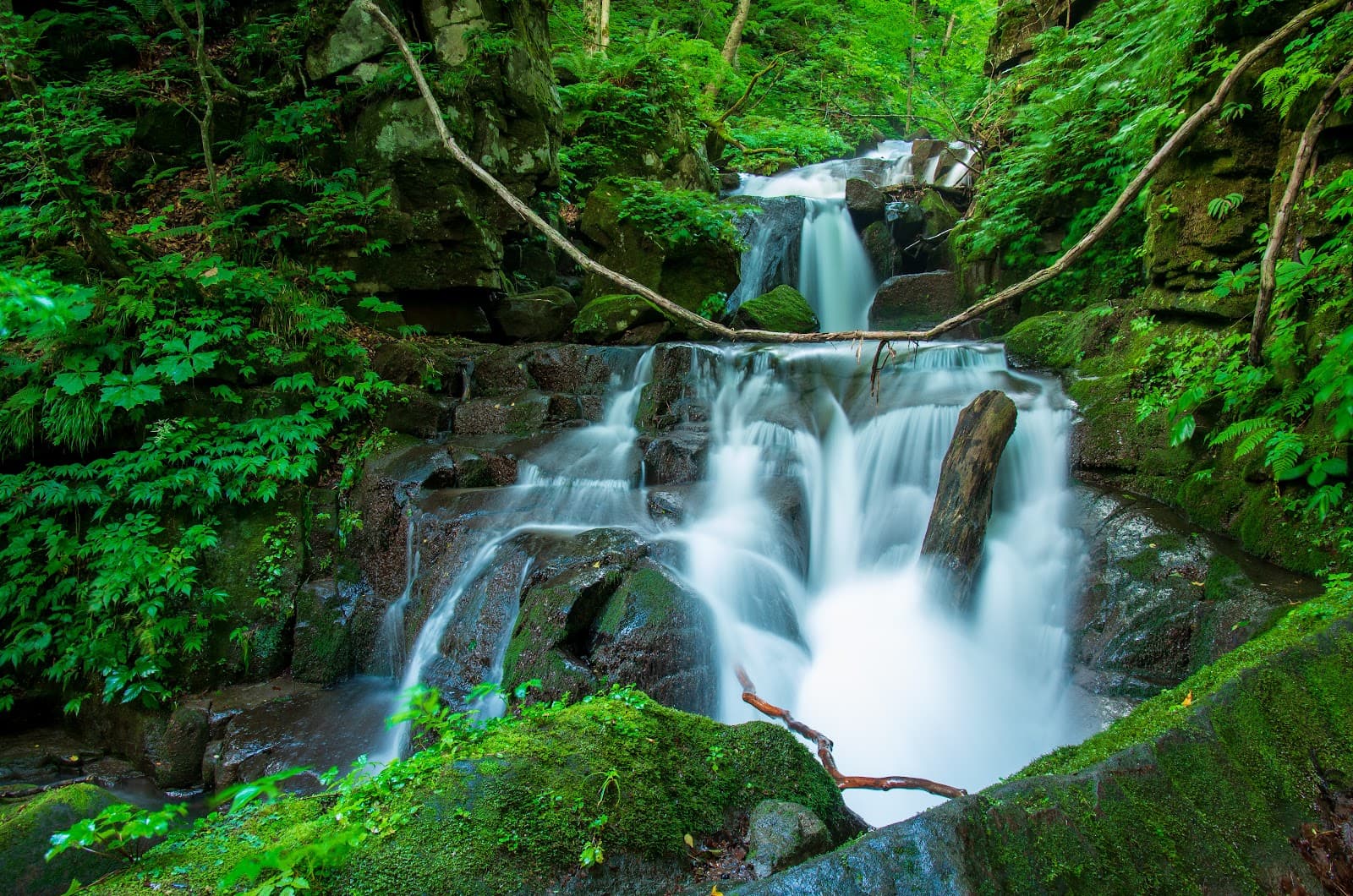
Choshi Falls (4.5★) is the most visited single point on the trail - a wide, tiered drop about 2.5 kilometres from the Nenokuchi trailhead at the lake end. It earns that attention: the falls are around 7 metres high and 20 metres wide, and the viewing platform puts you at water level. If you only have 90 minutes, walk from Nenokuchi to Choshi Falls and back.
Choosing Your Section
The trail is divided loosely into three parts:
Nenokuchi to Choshi Falls (2.5 km, 40-50 min one-way) - This stretch has the highest concentration of waterfalls and the most dramatic moss-covered boulders. Choshi Falls is the visual centrepiece. Walk it from Nenokuchi heading downstream (south) so you have the falls at the far end rather than at the start. The bus from the lake stops at Nenokuchi.
Choshi Falls to Ishigedo (5 km, 1.5 hours one-way) - The middle section is quieter, with a series of smaller cascades including Kumoi Falls and Fuji Falls. The path widens in places and the forest opens slightly. Ishigedo has a rest area and bus stop, so you can break the walk here if needed.
Ishigedo to Yakeyama (7 km, 2 hours one-way) - The lower section is the least visited and the flattest. The stream slows and the gorge walls recede. Worthwhile for birding (dippers and kingfishers are common) and complete solitude in shoulder season, but the scenery is noticeably less dramatic than the upper stretch. Skip this section if your time is limited.
The full 14-kilometre walk from Nenokuchi to Yakeyama takes around four hours at a relaxed pace with stops. Plan for five if you photograph everything. Buses run between Yakeyama and Nenokuchi along Route 102, so you can walk the whole thing one-way without retracing your steps.
Getting There From Aomori
Aomori is the most practical base for Oirase Gorge. The journey combines a JR train and a JR Bus.
Aomori Station to Towadako Bus Terminal - Take the JR Bus Tohoku service (Towadako Line) direct from Aomori Station Bus Terminal. Journey time is approximately 2 hours 20 minutes. The fare is around ¥2,840 one way (check the current JR Bus Tohoku fare on the day). Buses run 2-3 times daily depending on season; check timetables at Aomori Station or on the JR Bus Tohoku website as schedules change seasonally.
Alternatively, travel by Shinkansen from Tokyo to Shin-Aomori Station (about 3 hours on the Hayabusa service, ¥17,000-¥18,000 unreserved), then connect to Aomori Station by local train (10 minutes, ¥200), then pick up the bus above.
The bus from Aomori stops at multiple points along Route 102 through the gorge - Yakeyama, Ishigedo, and Nenokuchi - before terminating at Towadako Bus Terminal on the southern shore of the lake. This means you can board at Yakeyama and walk upstream, or ride to Nenokuchi and walk downstream. Boarding at Yakeyama is the better option in autumn because you walk toward the lake and can continue to the lake shore without backtracking.
Getting There From Hachinohe
Hachinohe is useful if you are travelling the Tohoku Shinkansen from Tokyo and want to break the journey into Aomori. However, direct bus connections to Oirase are less frequent than from Aomori.
From Hachinohe Station, take the JR Bus Towada Kanko service to Towadako via the gorge. Journey time is approximately 2 hours. Fares are around ¥2,500 one way (confirm current pricing). Buses run 2-3 times daily in season. Outside of peak season (roughly mid-October to mid-November), some departures are suspended, so check timetables before building an itinerary around Hachinohe.
For most visitors on a Tohoku loop, Aomori is the more reliable hub.
Lake Towada: What to Do After the Gorge
Lake Towada (4.4★) is the largest caldera lake in Honshu, sitting at 400 metres above sea level with a maximum depth of 327 metres. The water is cold and clear enough to see 9-10 metres down in calm conditions. The southern shore (Yasumiya area) is where buses terminate and where most facilities are located.
The lake cruise - Excursion boats run from Yasumiya Pier to Nenokuchi, covering the southern half of the lake in about 50 minutes. The fare is approximately ¥1,400 one way or ¥2,000 return (check current pricing at the pier). A sensible approach is to take the boat one-way from Yasumiya to Nenokuchi, then walk the gorge back downstream. This avoids backtracking and keeps the whole day moving in one direction. The cruise is most atmospheric in early morning when the lake surface is flat and the surrounding hills are reflected in the water. The boat service typically runs from late April to mid-November; winter services are suspended.
Towada Shrine (4.4★) - A five-minute walk from the Yasumiya bus terminal through cedar forest. The approach path is shaded and the shrine building is modest in scale, which suits the quiet forested setting. Worth 20 minutes. The surrounding woods feel separate from the tourist facilities at the lakefront, and it is noticeably emptier than the pier area even during autumn peak.
The Seibo Statue at Yasumiya - Two bronze female figures standing back-to-back on the lakeshore, created by sculptor Kotaro Takamura and installed in 1953. Free to view. The sculptures are often photographed as a foreground element against the lake. They are included in the Lake Towada listing (4.4★) as the site's best-known landmark.
Hakka Touge Observatory (4.1★) - Located on the mountain road between Towadako and Kazuno, this viewpoint gives an elevated angle over the lake and the surrounding caldera rim. Accessible only by car or a long walk; it is not on the bus route. Note this only if you have your own transport.
Ohanabe Mountain Viewpoint (4.2★) - Another elevated viewpoint above the western shore, again requiring a vehicle or a tough uphill walk from the lakeside. The lake's scale only becomes clear from above, so this is worth the detour if you have a car.
Autumn Foliage: Timing and Trade-offs
Oirase Gorge is one of the most photographed autumn-leaf settings in Tohoku, and the crowds reflect that. Colour typically begins at the highest points around the caldera rim in mid-October, reaches the gorge proper between 20-25 October, and peaks at the lower gorge and lakeside in the first week of November. The exact date varies by 5-7 days year to year depending on whether September was warm or cool.
The trade-off is direct: peak colour coincides with the highest visitor numbers of the entire year. Route 102 through the gorge is closed to private vehicles on peak weekends (usually two or three weekends in late October and early November), and shuttle buses replace car traffic. This is actually better for walkers - the path is quieter without cars on the parallel road, and the shuttle stops make the logistics easier. Check the Aomori Prefecture website for the specific closure dates each year as they are announced in September.
For the best experience during peak season, arrive at Nenokuchi on the first bus of the day (the Aomori bus departs early morning; check current timetables) and walk downstream. By 10 am the gorge fills with day-trippers. Early light through the beech canopy is a practical reason to start early, not just a crowd-avoidance tip: the golden colour of wet leaves is more saturated in low-angle morning light than midday.
If autumn colour is not your priority, late May to early June is a very different experience. The forest is intensely green, water levels are high from snowmelt, and the gorge is genuinely quiet. Snow can still cover the surrounding hills into late April, and some bus services don't resume until late April or early May.
Winter (December to March) is cold and the gorge is partially snow-covered, which is striking in its own way. However, bus services are severely reduced and the lake cruise is suspended. Walking is possible but requires proper footwear and some experience with icy paths.
For a broader look at timing Tohoku's autumn colour across multiple sites, see our guide to autumn leaves in Tohoku's lesser-known outstanding spots. For context on how accessible Towada-Hachimantai National Park is compared to other Japanese parks, the guide to Japan's most accessible national parks covers the practical comparison.
Practical Notes
Footwear - The gorge path is well-maintained gravel and stone but becomes slippery when wet. Trail shoes or waterproof walking shoes are the minimum; trainers work in dry summer conditions but are a liability in autumn rain or early spring mud.
Facilities - Toilets at Nenokuchi, Ishigedo, and Yakeyama. A rest house at Ishigedo sells hot drinks and simple food. The Yasumiya lakeside area has a couple of restaurants and a visitor centre with trail maps.
Mobile signal - Patchy through much of the gorge. Download offline maps before leaving your accommodation.
Length and effort - The full 14-kilometre walk involves negligible elevation gain (the trail follows the stream downstream). It is not physically demanding for fit adults. The surface is uneven in places and the footing requires attention, but this is not a mountain hike. For more context on accessible hiking options across Japan, see the guide to Japan's most accessible national parks.
Accommodation - Staying at Towadako Onsen (the cluster of hotels at Yasumiya) allows an early morning start on the gorge before day-trippers arrive by bus. This is genuinely worth considering in autumn, when hotels book up 2-3 months ahead. Book early or accept a Hachinohe or Aomori base with a long day-trip.
Budget summary - Return bus from Aomori approximately ¥5,680. Lake cruise one-way approximately ¥1,400. Gorge trail: free. Towada Shrine: free. Total day-trip cost from Aomori excluding food: around ¥7,000-¥8,000.
One Day, One Direction
The most efficient single-day itinerary from Aomori: early bus to Yakeyama, walk upstream through the full gorge to Nenokuchi (14 km, arriving mid-afternoon), take the lake cruise from Nenokuchi Pier to Yasumiya, visit Towada Shrine, and catch the late-afternoon bus back to Aomori. This covers everything in one continuous direction without doubling back. It is a full day and requires the first available bus from Aomori, so check current timetables the evening before.